Leading Yourself
Emotional Debt: Why the Past Keeps Hijacking Your Present
The reaction out of proportion is never about the present. What emotional debt is, how it runs your leadership from backstage, and the protocol for discharging it on purpose.
· Leading Yourself · 9 min read
Watch · 31s
Prefer to watch? The whole essay, in 31 seconds.
Same argument, same ending. The written version is right below.
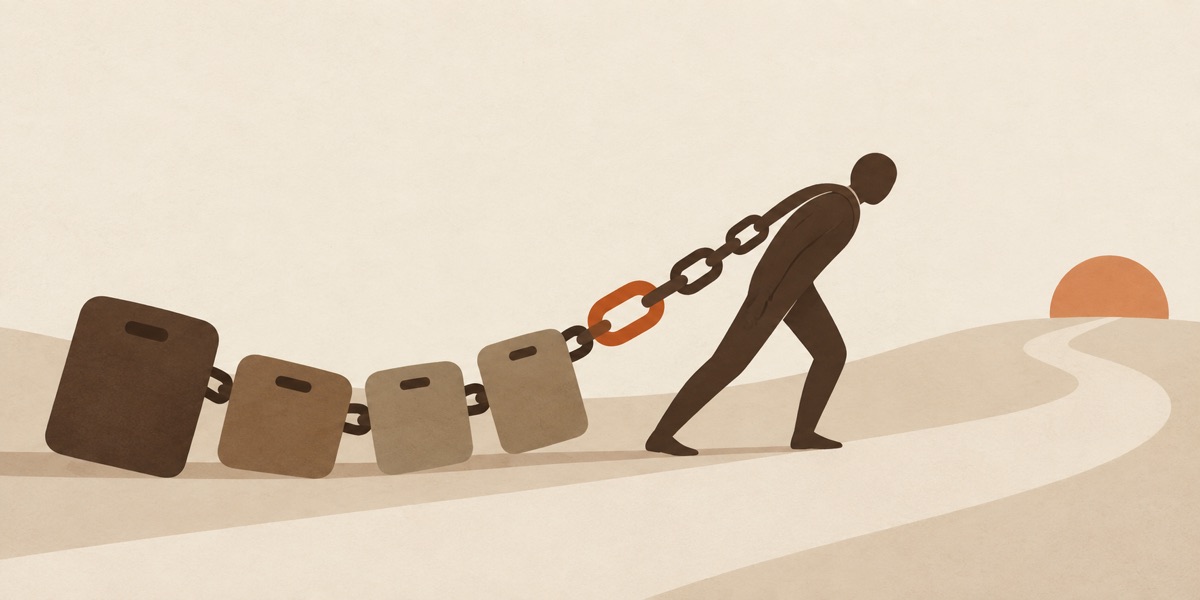
You had a calm Tuesday planned. At 10:14 someone said — mildly, almost certainly without malice — “that’s the second time this has slipped.” And something in you went hot, fast, in a way that had nothing to do with the sentence. The reply you drafted in your head was written by someone else. Someone younger.
That wasn’t the present reacting. That was a bill coming due.
Call it what it is: emotional debt — the stored, unresolved weight of past events you never fully processed, still carrying charge, still wired into the present. Everyone carries some. Leaders carry more, because leadership absorbs upsets from a whole team and rarely has anywhere to put them. And debt does what debt does: it sits quietly, it accrues interest, and it collects — usually at the worst possible moment, in front of the people who least deserve it.
How the hijack actually works
The mechanics are worth knowing precisely, because vague guilt about “baggage” helps nobody.
An event you didn’t fully process doesn’t get filed away — it gets staged. The scene, the feeling, and especially the conclusion you drew at the time (“I’m not taken seriously,” “when I speak up I get punished,” “I’m only safe when I’m perfect”) stay bundled together, live, waiting. A bundle like that doesn’t decay with time. It just gets quieter.
Then Tuesday happens. Some element of now — a phrase, a tone, a power arrangement — resembles some element of then, loosely. The bundle fires. And for the length of the reaction, you are not in the room. You’re time-traveling: a forty-five-year-old executive responding, at speed, to a scene from decades ago, with the stakes and the logic of that older scene — while your actual colleague, who made a scheduling observation, watches your face and wonders what they did.
The tell is never the topic. The tell is disproportion. A reaction with heat ten times the size of its trigger is never about its trigger. It’s a collection call.
What debt costs a leader
Unconscious debt taxes exactly the things leadership runs on.
Reads go wrong. Neutral events come back distorted. A restructuring rumor feels like the time you were blindsided, so you treat a routine org change as a betrayal in progress — and act accordingly, loudly. A reasonable question from a board member lands as the old interrogation, so you defend instead of inform.
Feedback becomes landmine clearance. Teams are expert readers of power. Within a quarter, they map your triggers without effort — everyone always knows where the mines are — and the company quietly redesigns itself around your unprocessed past: topics get softened, data gets pre-spun, the person who’d tell you the truth about your blind spot instead tells a colleague, generously, “it’s not the week.” Your organization becomes measurably less honest in exact proportion to your unexamined reactions, and none of this appears on any dashboard.
The debt gets inherited. Worst of all, what you can’t feel, you tend to enforce. The leader who was punished for imperfect work runs a culture of quiet punishment for imperfect work — not by policy, just by what their face does in review meetings. The past doesn’t just hijack your present. It drafts your team’s.
The discharge protocol
Debt doesn’t need years of excavation to move. Most of it responds to a short, deliberate protocol — the same one, done honestly, in a calm setting, on purpose. It’s unlearning work: not adding insight, but un-fusing the old conclusion from the present.
1. Catch the disproportion. The entry point is always a reaction you can admit was too big. You don’t need to find your deepest material in week one — just the most recent overreaction. It’s fresher, and the wiring is easier to observe.
2. Locate the original scene. Ask one question, without rushing: when was the very first time I felt exactly this? Not similar — exactly this, this signature of heat plus helplessness plus a specific old dread. The answer usually arrives fast, which surprises people. It was never buried; it was just never asked.
3. Date-stamp it. This is the step that changes everything, and it’s one sentence: “This reaction is twenty-eight years old.” Said out loud, it does something no insight ever does — it separates then from now, administratively. You’re not dismissing the old event or arguing with your feeling. You’re establishing jurisdiction: the scene is real, and it is over, and the colleague in front of you is not in it.
4. Feel it deliberately, on purpose, in a safe setting. Not suppressed mid-meeting, not white-knuckled — scheduled. Ten minutes alone, walking or sitting, letting the old scene’s heat actually run through you while you stay put. The charge you allow on purpose doesn’t need to ambush you on schedule. This is the payment itself, and it’s why the step can’t be skipped or thought at.
5. Re-decide. The bundle holds an old conclusion (“stay quiet,” “be perfect,” “trust no one”). Conclusions can be updated by their owner. Write the new one, in your own hand, present tense: “My job is to surface problems early, and I am safe when I do.” One sentence. The old wiring loses its job description.
Run the five steps once per episode, and notice what changes: the next trigger arrives and the heat comes up and then a half-second of space opens — the date-stamp, arriving on its own. That half-second is the whole game. Reaction minus half a second is leadership.
The honest boundary
Two limits, said plainly. First, this protocol is for the ordinary debt of a working life — criticism absorbed young, loyalties betrayed, failures that were never metabolized, the standard cargo of any driven person. Material of a deeper kind — anything involving real harm, terror, or abuse — deserves a trained professional, and referring there is a leadership act, not a failure of one. Second, discharge isn’t a one-time ceremony. You’re a working leader; new upsets arrive weekly and go unprocessed under deadline. The protocol is a maintenance practice, like flossing — cheap when routine, expensive when deferred.
The leaders worth following are mostly this, underneath the skills: people who own their own pasts, so their teams don’t have to.
This week's practice
Keep one log line per day: any reaction you can admit was bigger than its trigger. No analysis, no fixing — just the entry, and one word for the heat. Seven lines by Sunday.
Then take the biggest one and run the protocol in full: locate the first time you ever felt exactly that, date-stamp it out loud, give it ten deliberate minutes where it's safe, and write the one-sentence replacement decision. Watch for the half-second of space at your next trigger — that gap is the return on this entire essay.
Foundations & further reading
The ideas here are my synthesis. The research that rhymes with them isn't new — if you want to go deeper than the essay, these are the sources I'd hand you first.
- Arlie Hochschild, The Managed Heart (1983) — The book that named emotional labor forty years ago: the cost of managing feelings you never chose to express. The original balance sheet for emotional debt.
- James J. Gross, The Emerging Field of Emotion Regulation: An Integrative Review (1998) — The process model of emotion regulation: suppression costs you capacity; reappraisal pays it back. The mechanics behind paying the debt down.
- Bessel van der Kolk, The Body Keeps the Score (2014) — What unprocessed experience does to the body and to the present tense. Heavy artillery, but this is the research people mean when they say the past runs the show.