The Coaching Craft
The Right Gradient: Why Coaching Too Fast Breaks People
Gradient — the step size of change — decides whether coaching lands or breaks. How to read a client's actual gradient, why brilliant coaches get it wrong, and how to find the step they can take.
· The Coaching Craft · 8 min read
A new executive client — sharp, funded, ambitious — wants to transform his leadership “this quarter.” He’s read the books. He has the frameworks. Six weeks in, his team is more confused, more guarded, more brittle than before. Not because the advice was wrong. The advice was right, all of it, and that’s exactly the problem: he changed five things at once, each one correct, and his team experienced it as an earthquake with no explanation.
The failure wasn’t knowledge. It was gradient — the step size of change. And almost nobody in coaching, teaching, or managing has a word for it, which is why almost everybody gets it wrong.
What gradient is, and why it decides everything
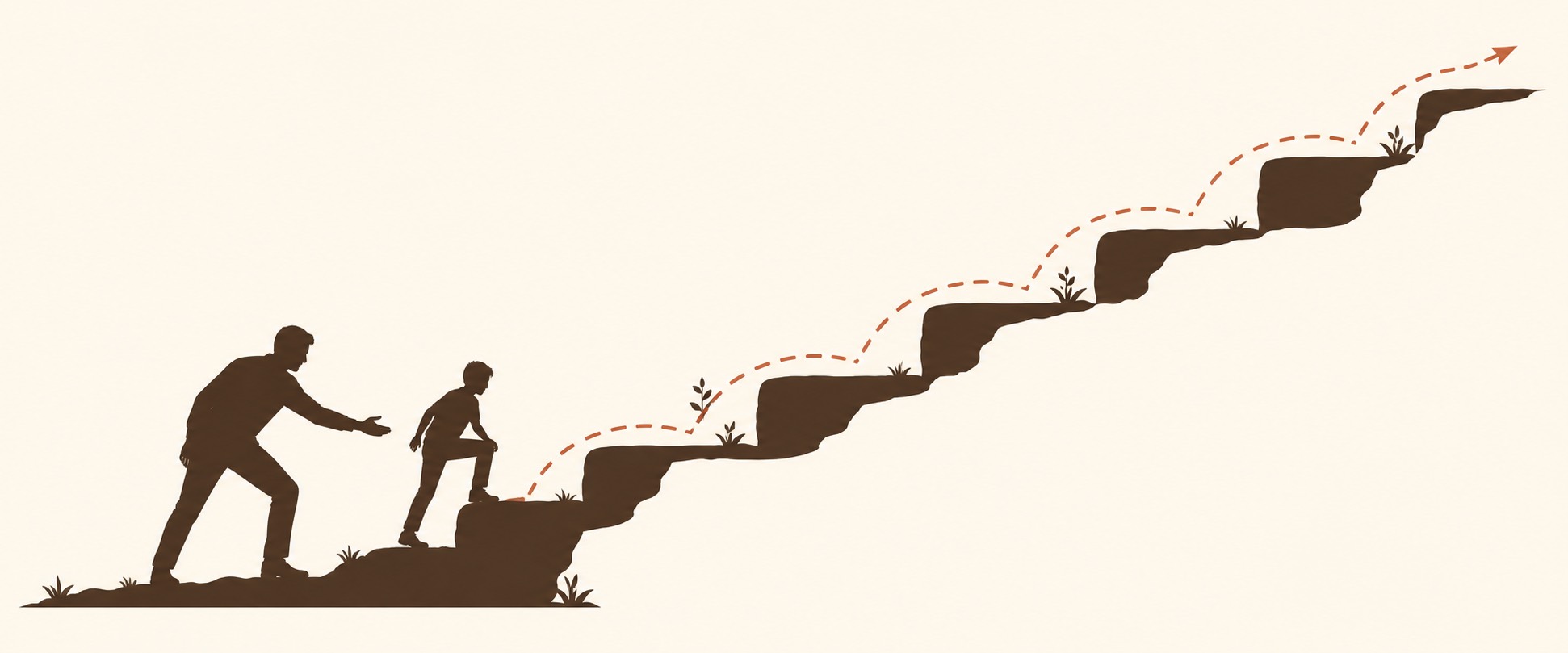
Gradient is the slope between where someone is and what you’re asking of them next. Every request you make of a client, a team, or yourself has one: quit micromanaging this week is a steep gradient; one fewer check-in per day this week is a shallow one. Same destination, radically different slopes.
Here’s the mechanism that makes it the difference-maker: people can absorb a step they can take, and they break — or perform — a step they can’t. When the step is too steep, most people don’t refuse it, they counterfeit it: they perform the new behavior publicly while the old pattern keeps running underneath. Compliance on the surface, old operating system below. That’s not stubbornness — it’s self-protection, and it looks exactly like success until the pressure returns and the real pattern resurfaces.
This is why coaching that’s too fast produces its most expensive failure mode: fake wins. The client reports progress. The coach reports success. Nothing actually changed because the change was requested at a slope the client couldn’t climb, so they acted it instead of building it.
How to read someone’s actual gradient
You can’t compute gradient in your head — you read it from response, in the room. Three signals, all observable:
- Latency. How long between your question and their answer? Instant, fluid answers mean the material is within reach. Long pauses aren’t bad — they mean the person is genuinely at the edge, which is where coaching happens. But a pause that stiffens into vagueness means you’ve outrun them: they’re no longer thinking, they’re hiding.
- Specificity. Real engagement produces specifics — names, numbers, scenes, last Tuesday. Fgradation produces generalities — “I guess I could communicate more,” “maybe I need to trust the team.” When answers go general, the person hasn’t connected the change to their actual life. That’s a gradient mismatch wearing agreement as a mask.
- Follow-through. The cheapest honest signal of all. Did the practice you assigned actually happen between sessions? Built-in change gets done; overloaded change gets postponed, rationalized, forgotten. A client who keeps “not getting around to” the work isn’t lazy — you’re handing them steps they can’t climb and their calendar is telling you before they do.
The three failures, and who makes each one
Too steep is the failure of the brilliant and the ambitious. The coach who’s read everything, the executive who wants transformation this quarter. The cause is usually projection: the coach’s own gradient — steep, fast, easy for them — gets assumed to be the client’s. What’s a hill for you is a wall for them, and you’re describing the view from the top as if describing it were climbing it.
Too flat is the failure of the kind. Low gradient feels like safety — small asks, gentle steps, no risk of overwhelming anyone. And it is safe, the way comfort mode is safe: permanent safety, zero growth. The flat coach’s clients stay for years, feel deeply understood, and change almost nothing. If nobody in your practice is ever uncomfortable, you’re not coaching — you’re hosting.
Just right is the craft. The step that makes the client slightly uncomfortable but still take the step — that specific band is where change happens, and holding a client in it, week after week, session after session, is the actual skill of this profession. Not the questions. The slope.
Finding the step they can take
The move that changes everything is embarrassingly simple: ask for less than you think they need, and make the less real. One behavior, one week, one context. “Don’t transform your communication — in Tuesday’s team meeting, ask two more questions than you naturally would, and report back what happened.” Small, concrete, and — because it’s small — actually done. Change that gets done at a climbable slope compounds. Change that gets admired at an impossible slope evaporates.
Then scale the step from the follow-through, not from the breakthrough. A client who did the small thing has earned the next size up. A client who didn’t do the small thing hasn’t failed — the assignment failed them, and your next move is smaller, not bigger. That reversal — the assignment is accountable to the client, not the client to the assignment — is the whole discipline of gradient in one sentence.
One more distinction worth the price of admission: the zone of proximal development isn’t the zone of comfortable strolling. The right gradient is not where the client is at ease — it’s the maximum slope they can still genuinely climb, which for most capable clients is considerably steeper than their comfort and considerably shallower than your ambition for them. Read it from latency, specificity, and follow-through — not from either of your moods.
This week's practice
Take one person you coach, manage, or parent. Ask yourself: of everything I've asked of them recently, which request had the steepest gradient — the biggest gap between who they are today and the behavior I asked for?
Now re-cut that one request into the smallest step that is still real — one behavior, one week, one context. Offer it, and watch the three signals: latency, specificity, follow-through. That's gradient, moving from theory to your calendar, which is the only place it ever mattered.